Echolalia Can Grow


(Photo description: yellow wildflowers by a split rail wood fence near a field)
In my writing about how all communication counts, I wrote about how my nonspeaking teenager used a lyric from a children’s song in the Spotify app to communicate that he wanted to leave the house.
“Five little ducks went out one day, over the hill and far away.”
It is not surprising to me that he sometimes uses music and other rich colorful multi-media to communicate.
I have watched him grow up all these years, to see that he is a “creative”.
His artistic tendencies are reflected in the modalities that he uses to communicate.
His communication often fluctuates and changes, mirroring his need for novelty, to have new communication canvases to explore.
I share here about how he uses multimedia to communicate along with his delayed echolalia, the borrowed language from lots of sources.
However, the most primary way he expressively communicates is not through language but rather through embodied communication.
His embodied communication can look like splaying his fingers when he is happy, stomping his feet when he is angry, or even making different kinds of whistles when he is content or surprised.
Sometimes he uses his whole body to answer questions such as “do you want to go upstairs or to the basement?”. He just simply moves himself to his choice.
I would estimate that embodied communication encompasses 85-90% of his communication on a daily basis.
Language is important because it is currently the most common medium used to communicate in our society at large, but it is still the hardest for him to access.
In our home, we view all of his communication as incredibly valuable, no one modality is superior to the other.
Even so, that teeny 10-15% of his expressive echolalic language whether expressed through multimedia or by ‘mouth words’ is incredibly interesting.
His delayed echolalia (a.k.a. gestalt language) continues to develop and grow in unexpected ways, in ways that don’t go according to the plan of others.
I think his echolalic language development is like watching wildflowers grow vs. potted flowers grow.
Both can grow, and both have their own beauty.
Potted flowers grow to look clean, crisp, fairly predictable, and beautiful.
Wildflowers grow to look softly rough, unruly, spontaneous, and beautiful.
I recently watched some webinar sessions for a virtual early childhood education conference.
One of the sessions noted that while there are general stages of human growth and development that are common among all humans, each person will still have their own unique developmental path.
When we think of developmental milestones such as walking for those who do not have significant physical disabilities, the journey to develop the milestone of walking will greatly vary.
There will be differences in the timing of walking, the location of walking, and the style of walking from human to human.
Some humans will emerge cautiously walking with tentative steps while others will take off running.
As a teacher and a lifelong learner in the topic of human growth and development, I find it all fascinating.
I journaled my own baby’s growth and development as a way to scrapbook it as a keepsake.
It turned into an ongoing documentation for much longer than I thought because my child, whom we nicknamed N, did not quite follow the neatly arranged milestones named in the charts and books about child raising.
At 10 months old, he did begin pointing and saying words.
Around 18 months he jumped from exclusively saying single words to speaking in delayed echolalic phrases which was language borrowed from other people, books, and songs.
He had feeding challenges and new arising delays in motor skills which led to seeing an occupational therapist (OT) which was followed by seeing a speech language pathologist (SLP).
The SLP worked on trying to teach N to use short spontaneous and novel phrases during fun play activities.
His speech gradually became more unintelligible and then use of speech declined significantly which brought a diagnosis of autism at age 3.
By 4 years old, the SLP services were clearly not working for him.
I heard about a therapy clinic that solely used the SCERTS framework, which targets “social communication” to develop language. We went ahead and gave it a shot.
The SCERTS approach of utilizing high rates of social engagement in an attempt to launch language development was disastrously overstimulating and we had to pull out. SCERTS did not move his communication forward, instead it pushed it backwards.
In hindsight, we have come to understand that large amounts of intense face to face interaction and turntaking increases his overall sensory load to the point of distress. This distress was not apparent during the SCERTS based sessions, but rather very shortly afterwards.
N’s own profile of motor and cognitive disabilities actually necessitate much lower rates of social engagement that is parallel or ‘side by side’ with communication partners to be able to process language input, and then he needs even more time after that to then move his body in response.
Our doctors at the time had been pressuring us to pursue applied behavior analysis (ABA) services since N’s autism diagnosis, and we finally got health insurance that covered it.
We found a ‘modern ABA’ provider who was an ethical, compassionate person. She was a parent of teenagers, and a former public school teacher with many years of experience.
So we tried the Verbal Behavior (VB) and Naturalistic Developmental Behavioral Intervention (NDBI) approaches with their environmental engineering strategies and “motivating” N through extrinsic means to develop language (aka “behavior modification”).
At our request, most of the ABA service hours took place at his play based nursery school. The goal there was to support inclusion within all aspects of the program. He engaged with painting, playing instruments, and digging in the mud alongside his same-age peers with the support of an ABA provider as a one on one aide.
He also had some time at home one on one with an ABA provider doing short bursts of direct instruction working on language skills with flashcards with lots of breaks in between to choose play activities where language was targeted in a more naturalistic and child led way.
After nearly two years of ABA, some boxes on the ABA assessment tool were checked off but there was no real authentic communication progress that translated to positive outcomes in everyday life.
We came to realize that N had a motor speech condition impacting his ability to speak. It was not simply a “social communication” problem nor a “motivation” problem.
Finally shortly before he was 6 years old he was diagnosed with apraxia of speech.
We found a local SLP private practice that actually had deep training and knowledge of augmentative and alternative communication (AAC).
Our AAC SLP’s in that clinic were truly gems and we learned from their tremendous generosity with lots of coaching and resource sharing.
I attended AAC trainings and conferences to learn all I could.
I printed out low tech boards of the high tech AAC language system we accessed for N.
I printed, laminated, cut out, and velcroed hard copies of the pictures of individual icons from the high tech AAC language system to demonstrate with low tech how to combine words in novel ways and then mirrored how to find those combined words on the AAC device.
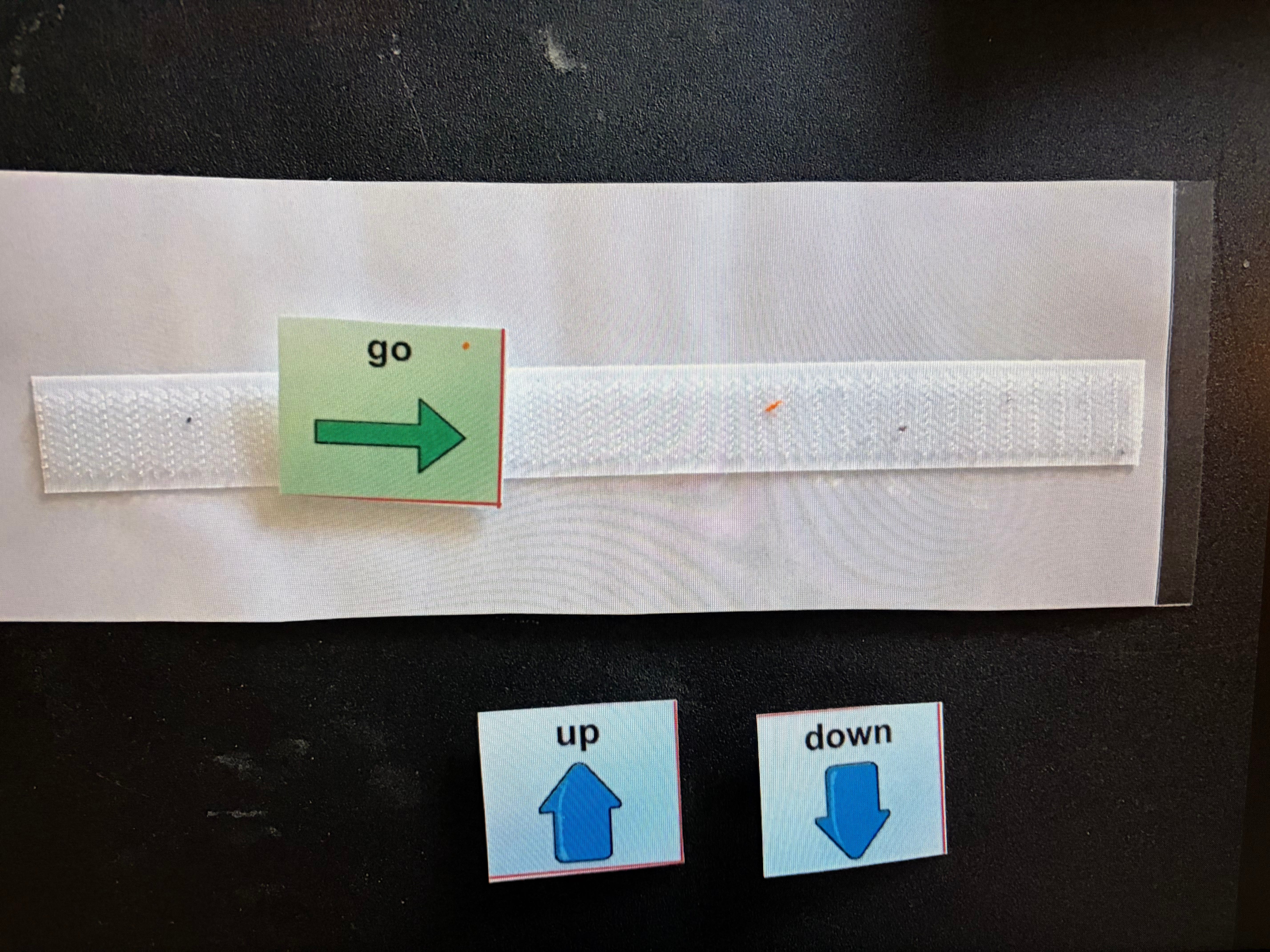
(Photo description: a low tech sentence strip with laminated words go, up, down)
There was high quality AAC device implementation in place with ample modeling, time for free exploration, space and opportunities were given to N to practice using language.
I was so ‘all in’ on supporting the AAC language system that I was affectionately dubbed an “AAC mom”.
Yet, N’s delayed echolalia would randomly ‘pop out’ out of the blue and he would speak an entire echolalic phrase that he’d heard in the past.
That language was often a lyric from a song, or language said by a familiar person repeated in the exact same intonation and cadence.
Back then I thought to myself, “well then, he just needs to know how to locate those words in the AAC language system and then he can express these echolalic phrases whenever he wants!”.
We continued to use the AAC device in daily routines. I even bought fun toys and created “pinterest” worthy activities to keep using language in fresh novel ways.
As time went on N seemed more and more confused, the chasm of his language use growing more scarce instead of abundant.
His silence had grown so loud that it was undeniable that something had gone terribly wrong.
Some may wonder why I embrace my son using echolalic language (a.k.a. gestalts), along with all the other ways he communicates.
Won’t that hold him back?
Won’t it stunt him?
Isn’t it sub-optimal?
Isn’t it a “crutch”?
Shouldn’t he be taught to use words in conventional ways?
For years, he was taught conventional ways to use language; to follow the predestined plans of others of how they thought his language development should be.
However, his language development is not a blank slate of nothingness. It never was.
The plans did not work because he already had language in his mind but was not able to consistently speak it from his mouth with speech.
He also could not carry the cognitive load and motor planning demands required to find and connect single words through pages of words contained in grid based columns and rows as commonly displayed in AAC language systems.
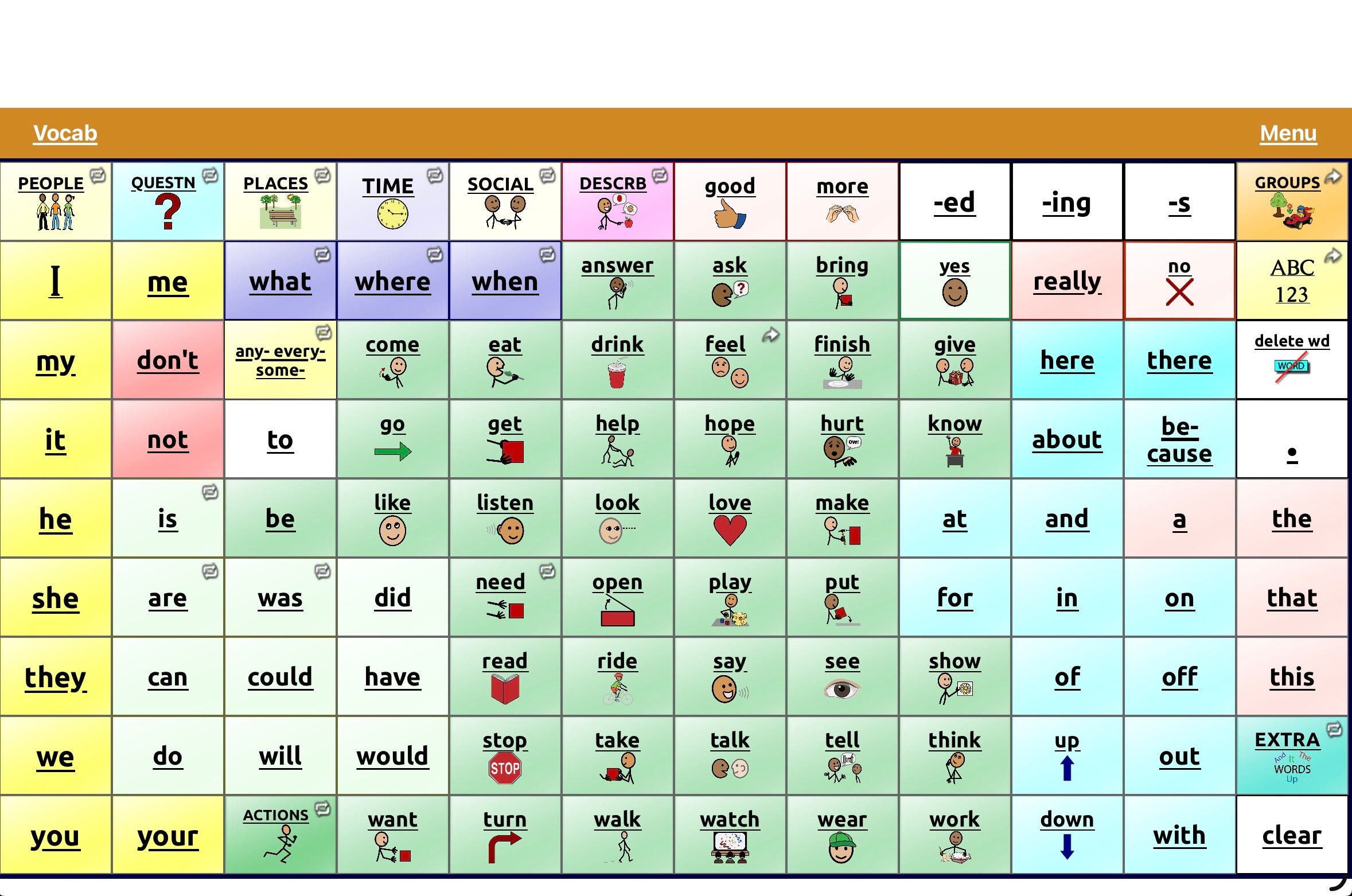
(Photo description: AAC app TouchChat Word Power 108 home screen, square grids and columns with many words and cartoon images)
His own echolalic language, borrowed from many sources, is already organized in his own mind.
It is organized according to his experiences, his emotions, his favorite melodies, and his visual memories, rather than by the fragmented squares of words paired with abstract cartoon icons in the AAC language systems.
He already had his own thoughts, and he had his own plans that better fit his preferences and strengths.
His plans are always better than what I, or others, could imagine
A few weeks had passed since he used a song lyric to communicate that he wanted to go out of the house.
“Five little ducks went out one day, over the hill and far away.”
I was sitting on the living room floor after doing some spring cleaning.
I had plans to kick my feet up and relax for the rest of the evening.
N came to the mudroom area by the front door, slipped his feet into his shoes, and stood in front of me expectantly.
I could perceive that this communication was likely a request to get out of the house once again, but I was hoping I was mistaken because I was quite tired.
It had also been quite a number of days since I had heard him express himself with speech.
I asked, “what do you need?”.
I asked him this question, knowing that he would likely take my hand and simply lead me to what he wanted.
I continued to look up at him.
There was a pause of silence.
N (spoke with his mouth): “Go!”
His unexpected spoken utterance took me back in time, to the past.
N first said “Go!” at 18 months old.
At 20 months old, he said the phrase “here you go!”, as well as a conjugation of the word “go” with his excited exclamation of “all gone!”.
A month later, he toddled around the house saying “Go Train Go!” which was the title of a Thomas the Train book he loved at the time.
At 2 ½ years old he loved our trips to the Lowes hardware store, he would pace around the room while reciting “go to Lowes” again and again.
He’d also used a second conjugation of the word “go” one day after I entered the room. He said, “what’s going on?” (go+ing). We did not hear him say that language again until a decade later.
When he was 3 ½, I had an outpatient surgical procedure and he had come with us to drop me off at the medical plaza in the early hours of the morning.
His dad got the call to come pick me up in the late afternoon.
N was in the living room, engrossed in an episode of a children’s tv show.
His dad stood by the door and called out, ”we gotta go pick up mom!”.
N looked at his dad, then back at the television.
Then he made an emotionally decisive move; he stood up to walk towards the door to go out into the car.
Thereafter, we heard him say from time to time, “we gotta go pick up mom!”.
Other than that, N was not using the word “go”, or any other expressive speech in any consistent way.
When he got his high tech AAC device at nearly 6 years old, we showed him the word go.
He explored the word “Go” on his own.
I often heard the flat synthesized voice flowing from the device as he repetitively pushed that icon.
“Go. Go. Go. Go. Go. Go”.
However, even though we had heard him speak with his mouth conjugations of the word “go” such as with “all gone” and “what’s going on?”, the AAC language system required two button hits to conjugate the word “go” (go+ing, go+ed etc.).
This multi-step process to communicate with language became a huge barrier to N’s language development. His significant cognitive and motor planning disabilities made it challenging for him to access grammar in AAC language systems by selecting single word by single word to build up phrases.
Years had gone by in trying to use the high tech AAC language system, it got to the point where the device was slowly being pushed away.
It was not simply an AAC “buy-in” problem, it was not an AAC implementation problem.
It was a huge mismatch between the echolalic language he already had organized in his own mind and the cognitive as well as motor demands of accessing the organizational and grammatical layouts in the AAC language system.
He did not make any progress with the grid layout icon based AAC system, and it was not a failure on his part.
It was our failure to truly meet his individual needs.
It did not mean that the AAC device should have never been given to him, nor that it should be taken away from him, but rather we needed to stop trying to bend him to fit with a traditional AAC language system and to pivot to other more personalized AAC options that actually opened doors to communication rather than shutting it out.
In January of 2020, when he was 9 years old, I had learned about a different way to support delayed echolalic language (a.k.a gestalt language development) that I had not been aware of which was based on the clinical research by speech language therapist Marge Blanc.
Since past therapy expectations for supporting language development had not been helpful, I gradually let go of nudging him to generate unpredictable “novel” utterances to focus on being more responsive to the language that he wanted to hear the most and engage with.
I found that he loved longer, consistently patterned, emotionally resonant, and melodic sounding strings of language.
I sang language from his favorite children’s songs into our everyday life, while brushing his teeth.
”This is the way we brush our teeth so early in the morning”
And watching summer rainstorms.
”It’s raining it’s pouring the old man is snoring”
It felt exactly the same as when he was young, before we fell into the world of pathologizing models of language development where echolalia is inconsistently viewed as communicative but is also seen as something to move past rather than attuning to it..
Becoming attuned to N’s echolalia was like going back home, to a familiar place.
It was a great relief for both of us to push aside the clutter of modeling a constantly revolving door of “novel” language to make room for the language that mattered the most to N.
Nearly a year later, in December of 2020, for the first time in forever N verbally spoke the word “go”.
Except, “go” was not a stand alone word, or a phrase with a “subject + verb”.
Instead the word “go” was inside of an entire gestalt phrase.
He exclaimed, ”Here it goes!”, while putting a piece into a puzzle.
Furthermore, the expression of the word ‘go’ was a completely new conjugation (go+es).
The year 2021 brought the gestalt in the form of a question, “where did it go!?”.
And then another gestalt was spoken that was a hint that it was time to eat, “mommy’s gonna make dinner” (‘gonna’ is a contraction meaning ‘going to’).
The year 2022 brought a gestalt for social conventions, “how’s it going?”.
Then a remix of an echolalic gestalt from nearly decade before “go to Lowes” was transformed to “go to________”.
”Go to bed” (when we were driving to a park)
”Go to the left” (from song ‘The Gold Fish: Let’s Go Swimming”)
”Go to the doctor” (while getting his temperature taken)
The year 2022 ended up being a very remarkable year.
On his own, he began to break off single words from his echolalic phrases.
It is a common guidance when supporting gestalt language development to model ‘whole’ or complete salient phrases, that when chosen to be acquired by a person, can eventually be easily mixed and matched to communicate different ideas.
One popular phrase that children who primarily use gestalt language often pick up on as a gestalt is, “Let’s _____”. It is a great piece of language that has such powerful potential for self advocacy.
Many years prior, I had documented N speaking the echolalic language “Let’s go back to bed”. So I re-introduced that language consistently and modeled remixing it in everyday life.
Since he cannot consistently access speech with his mouth , the remixed gestalt phrase “Let’s go upstairs” was programmed into a high tech AAC visual scene display (VSD) about his bedtime routine.
VSD’s, which are not talked about enough, are a research based form of AAC which attaches language to a picture of a particular moment in time.
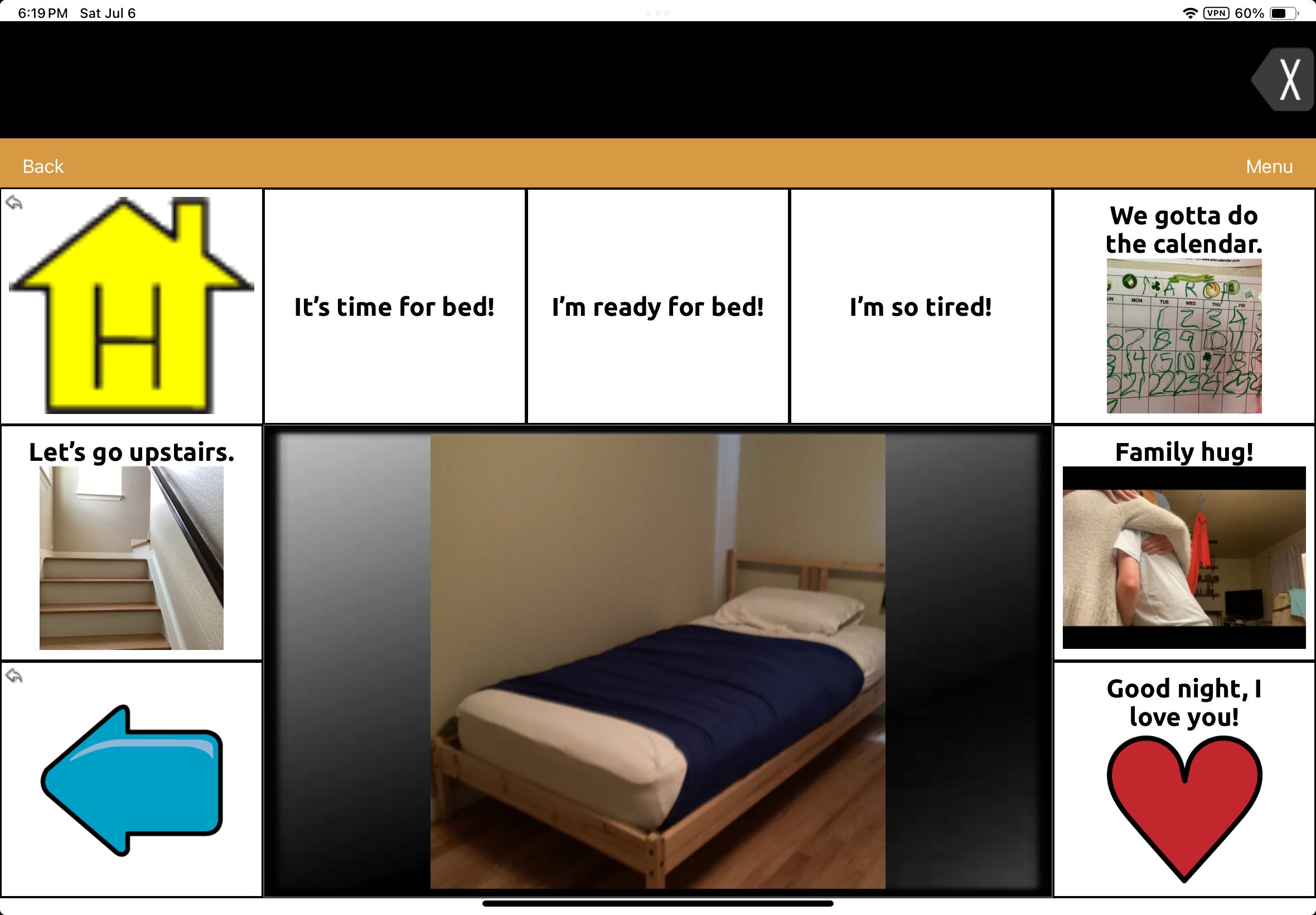
(Photo description: a screenshot of a visual scene display of a person specific bedtime routine, a large picture of a twin bed is surrounded by person specific gestalt phrases such as “it’s time for bed”, “let’s go upstairs”, and “family hug”)
I consistently used that language, “let’s go upstairs”, whenever it was time to head up for bed.
He explored that language in the AAC device whenever he wanted, which was quite often.
One dark night he quietly spoke out a piece of that gestalt language from his mouth, “Upstairs”.
A single word pulled off from echolalia.
In 2023, another change came, this time that language “Let’s go upstairs”, was spoken with speech but was pared down to a more generic application, “Let’s go!”.
While I do not believe that N had zero understanding the meaning of the individual words in his echolalic phrases, I do speculate that because echolalia is a very consistent language. His understanding of the different meanings of words and how words worked together within his echolalia simply crystalized and became clearer over time.
I also speculate that when N saw his echolalia written out visually exactly as he intended, all at once, as a ‘whole’ gestalt in the visual scene displays of his AAC device, he could self-study them to better see and hear the word boundaries.
He could see the auditory sound stream of, “Let’sgoupstairs”, in written form actually looked like “Let’s go upstairs” thus making it easier to parse out the single words within that phrase.
Engaging with his echolalia released him to be free to have language organized in a way that was cognitively and motorically consistent and accessible to him.
Some of his echolalia could be universally copied and pasted to any new experiences, so I began using this echolalia to communicate whenever it seemed right such as:
Look at that! (2018)
Here it goes! (2020)
How’s it going? (2021)
That’s what it’s all about! (2022) -from song “Hokey Pokey”
The echolalic language that he loved most often had consistent beginnings. This made it easier for N to access language whether by mouth or selecting that language in a visual scene display (VSD).
Below are some examples of his echolalic language with consistent beginnings.
(Note, I have included some documented echolalia with consistent beginnings from before I learned about how to support gestalt language development in 2020. He expressed delayed echolalia way back then, but we were so focused on him generating novel utterances via mouth words, then by an AAC device, that his language did not get the support it needed to grow)
We gotta go pick up mom! (2014)
Look at the blue hair. (2018) (referencing Toca Hair Salon app)
Sounds like an elephant! (2018) (in reference to a squeaky chair)
There’s the bus! (2020) (video wheels on the bus)
I also began showing him through everyday interactions how to remix (or “mitigate”) this echolalic language.
“We gotta go pick up mom!” could be changed just a little bit to fit a new experience, “We gotta go outside!” or “We gotta go eat dinner!”.
The changes in his emotional affect were almost immediate, he showed me through his embodied communication the language he loved most. Four months after his gestalt language development began to be supported, he slowly started using echolalic speech via mouth words again a few times a day.
(see numbered list above for the original echolalic language that corresponds with the remixed echolalic language below)
We gotta go trick or treat (2022) (referencing going out at night)
Look at the bug (2021) (looking at a picture book)
Sounds like a horse (2021) (playing with AAC device animal sounds)
There’s the fire station! (2022) (referencing a photo of Lowes lawnmowers)
The consistency of his own echolalic language gave a placeholder, a frame of reference similar to a mnemonic device to help his language to grow by simply removing a language chunk or word and then slotting in another language chunk or word.
(a mnemonic device is a learning technique that uses a memory strategy that associates information to something that is easier to remember or recall such as memorizing a loved ones new phone number or address by incorporating it with a familiar melody or rhyme)
The frame and slot style of recommended language support for early gestalt language development, particularly as described in the clinical work of speech language therapist Marge Blanc, also reminds me of a few literacy strategies included in the literacy framework for students with cognitive disabilities, Comprehensive Literacy for All (CFLA): 1) reading predictable text, 2) predictable chart writing, and 3) the keyword and word wall approach
There are many books with predictable text, or language, but one widely known early childhood example would be author Eric Carle’s “Brown Bear, Brown Bear What Do You See?”.
In the CFLA book (2020) it talks about how predictable text helps students make sense of what they are reading. When reading predictable text, students “gain sensitivity to text structure, acquire vocabulary, and participate more readily and successfully” (p.128).
Then with predictable chart writing, students can also learn to recognize sentence structures by writing with sentence stems where a predictable chunk of language is given and a student can fill in the rest. This activity can be extended further by completing other steps of predictable chart writing routines such as cutting apart the sentence and then reconstructing it (p.81).
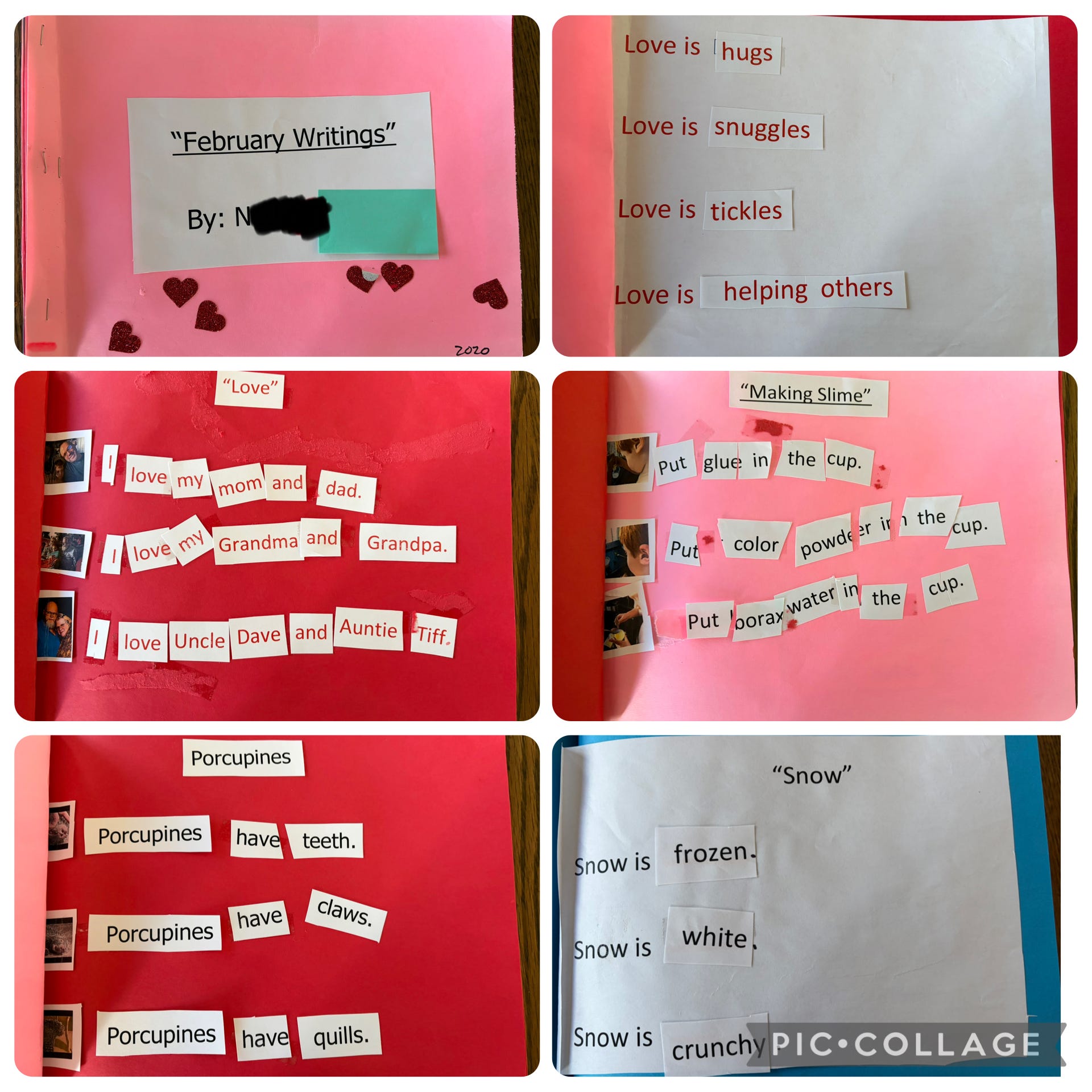
(Photo description: Six pages of a homemade book of predictable chart writings for the month of February are shown. Sentence stems are Love is___, I love my___, Put ____in the cup, Porcupines have____, Snow is_____.)
Prior to knowing about gestalt language development, I had used predictable text and predictable chart writing with N in our homeschool. He did and still does enjoy being supported to engage in these types of literacy activities,
Another strategy used for reading and writing that can be helpful for students with cognitive disabilities is the “keyword’ approach (p.171) and referencing word walls.
The keyword approach can be used when students have had ample time interacting with the alphabet and with word families (-at family: cat, bat, fat, hat). Then they can readily learn to recognize the patterns of words and use a keyword that is visually posted on a “word wall” as a reference point to make a new word that has a similar pattern.
For example, a student might want to write the word “CAKE” but struggles with writing the word completely from scratch. If a similar word such as “MAKE” is displayed on a word wall, a student can see that they can swap the initial letter “M” out and put in the letter “C” to make the new word “CAKE”.
I learned from CFLA that predictable language and text can leverage access to literacy for people with cognitive disabilities.
However, it had not occurred to me to apply using predictable language that N loved as an everyday conversational strategy to support his language development.
Having access to a predictable consistent language, through his own echolalia, has helped his language (and literacy!) to continue to grow. He can better recognize language structures, build vocabulary, and participate in conversations.
He went on to speak the conjugated word ‘go’ in other echolalic phrases.
“Where you going?” (caregiver walking away)
“It goes squish squish” (sound effect of walking in mud)
As he became a teenager, I looked over the small language sample collected, not over a 60 minute session, but rather over the course of years.
I noticed generally with his language that conjugations of verbs, such as with the word “go”, were developing.
However, his conjugations of verbs all happened within the spaces of his echolalic phrases.
Back then, I pondered over the fact that he had expressed the words go, gone, going, goes and gonna, but curiously the past tense conjugation of “went” was absent.
In 2024 and 2025, there was a big drop in spoken and multimedia language use that was concurrent with a huge uptick in embodied communication.
In those two years, he expressed a small amount of spoken echolalic gestalts but none contained the word “go”.
When N does use spoken echolalic language it has different purposes for him.
It is a way for him to explore language, rehearse language, recall past experiences, ask questions, express feelings, and to express some of the things on his mind.
For him, this spoken language typically comes out unexpectedly.
It comes hours, days, months, or years later from the original time he’d first heard it.
Yet, spoken language has not been a primary form of expressive communication for him since the age of 3 years old.
That is why we have leaned into a comprehensive total communication approach, where language is just one part of his many communication modalities.
All communication is honored equally, even communication without words at all.
If words come, that is awesome, if they don’t that is okay too because words aren’t the only way to communicate.
In 2026, now aged 15, another spoken gestalt with the word “go” quietly emerged.
“Are we gonna go?” (while transitioning to another activity).
Just a couple months later came the song replays on Spotify to indicate that he wanted to go out of the house.
“Five little ducks went out one day, over the hill and far away”
I remembered later that he had expressed through delayed echolalia all the conjugations of the words: go, gone, going, goes, gonna.
And now the word ‘went’ had subtly emerged through a song he played from a tablet.
N has been exposed to the word “went” many, many times over his lifetime.
I don’t know that he had ever used that word to communicate a thought.
Perhaps he did, and no one noticed or realized it?
All I know for sure is that his echolalic language is deepening, evolving, and growing over time.
Now back to the living room in 2026.
N had gotten his shoes on and was expectantly standing in front of me.
Me: “what do you need?”
A pause of silence.
N (speaking with his mouth): Go!
Me (stammering in surprise): Go!?….where?”
A pause of silence.
N (speaking with his mouth): Go….out!
It was a spontaneous extraction of words from his large bank of his echolalic language.
Echolalia is a beloved language that he has collected deep into his soul. It is language bonded to his lifetime of meaningful and emotional experiences.
“Go to Lowes.”
“We gotta go pick up mom.”
“Let’s go upstairs”
”Let’s go”
“Here it goes!”
“Where did it go?”
”5 little ducks went out one day”
(along with many, many more acquired echolalic gestalts over the years that have not been mentioned here)
And then one evening, the extracted words came forth spontaneously and organically, ”Go out!”.
His unexpected, unplanned communication gave me renewed energy to get up, put on my own shoes, and let him lead me to where he wanted to go.
This world has ideas of how his language should grow, but his disabled body cannot meet those demands.
Echolalia is the language that he has, a rich language interwoven with a lifetime of memories, and we choose to empower him to use the language he has to the absolute fullest.
For the last 6 years, instead of trying to dump water on and prune back the leaves of his echolalic language, I now stand back and watch it stretch out to the sky.
I embrace the majestic view of his wonderfully unruly and wild language that belongs only to him.
And we went out that day,
over the hill,
and far away.
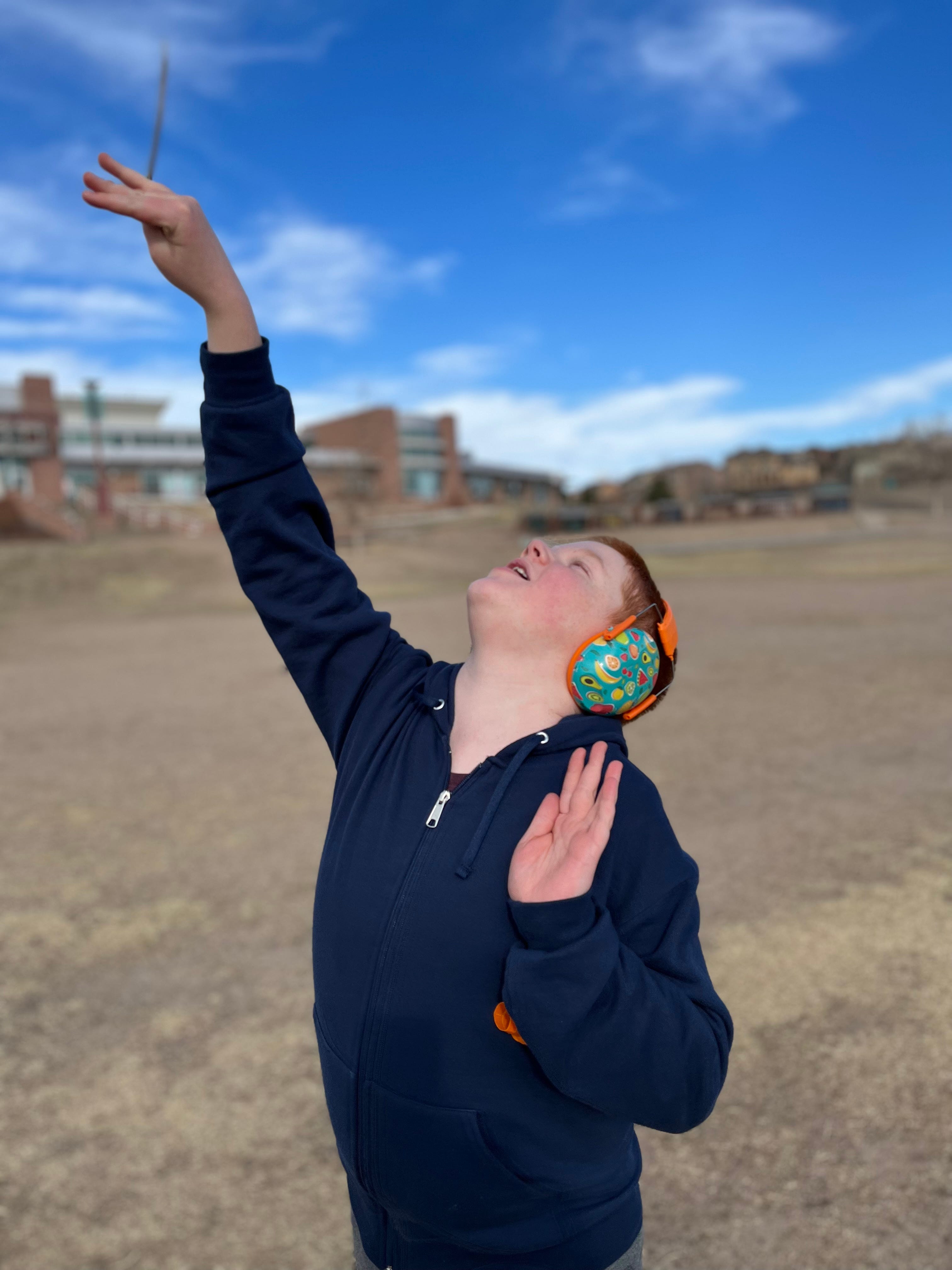
(Photo visual description: (taken back in 2022, a tween boy is confidently reaching up to the sky with his hand. At this time, he was just beginning to pull words out of his echolalia to communicate, while simultaneously still acquiring new echolalia. Here he had been humming the melody of a new to him song “Best Day of My Life” by American Authors, “I had a dream so big and loud, I jumped so high I touched the clouds, I stretched my hands to the sky”)