
Phonics and Creative Communications from One Autistic Nonspeaker (in 2023)
How intensive literacy instruction has empowered one nonspeaker’s literacy journey.

A couple years ago I made a video about an interaction I had with N during a phonics lesson, and then never shared it.
So this is going to be a Throwback Thursday kind of blog/vlog.
Before becoming a full time caregiver and homeschooling teacher, I put in nearly two decades of a career into teaching in public schools.
I feel so honored and truly fortunate to come to know hundreds of autistic students.
Many were fluent speakers, and some were nonspeakers, and some were in between.
Some autistic students found acquiring full literacy easy.
Some of my littlest autistic students, at just 3 or 4 years old, could take letter magnets and deftly make words like Disney and Netflix.
Some of my elementary autistic students, who were mainstreamed full time, needed more support and we plugged them into special education resource room services to address any literacy gaps they had.
As many of you may already know, N could always read because of hyperlexia, but never could spell.
Nevertheless, for many years he loved his letters and loved reading text.
I tried teaching him sequential synthetic phonics, adapted for nonspeakers, when he was around 6 years old, and he was not successful with it.
I tentatively tried it again at ages 7, 8, 9, 10….
I could have pushed him through it, but it would have caused him stress and frustration.
However, I knew he was such a letter lover and a bonafide, amazing self directed learner.
So I got him any and every toy and ipad app with literacy or letters that I could find.
Since he loved music, I showed him Youtube music videos about the alphabet and phonics.
Then I let him loose.
He was wild and free to feast on literacy and phonics on his own, in ways that made sense to him while I remained nearby providing support and encouragement.
He delighted in many of the resources I found.
And absolutely hated some of them.
Now looking back I can see that the literacy media that he loved the most during those very self directed years were very gestalt-y with stronger aspects of “wholeness”.
He loved the media that showed either the whole entire alphabet, or just single letters alone, and/or showed whole words and phrases.
The Starfall app was a favorite app of his for several years.
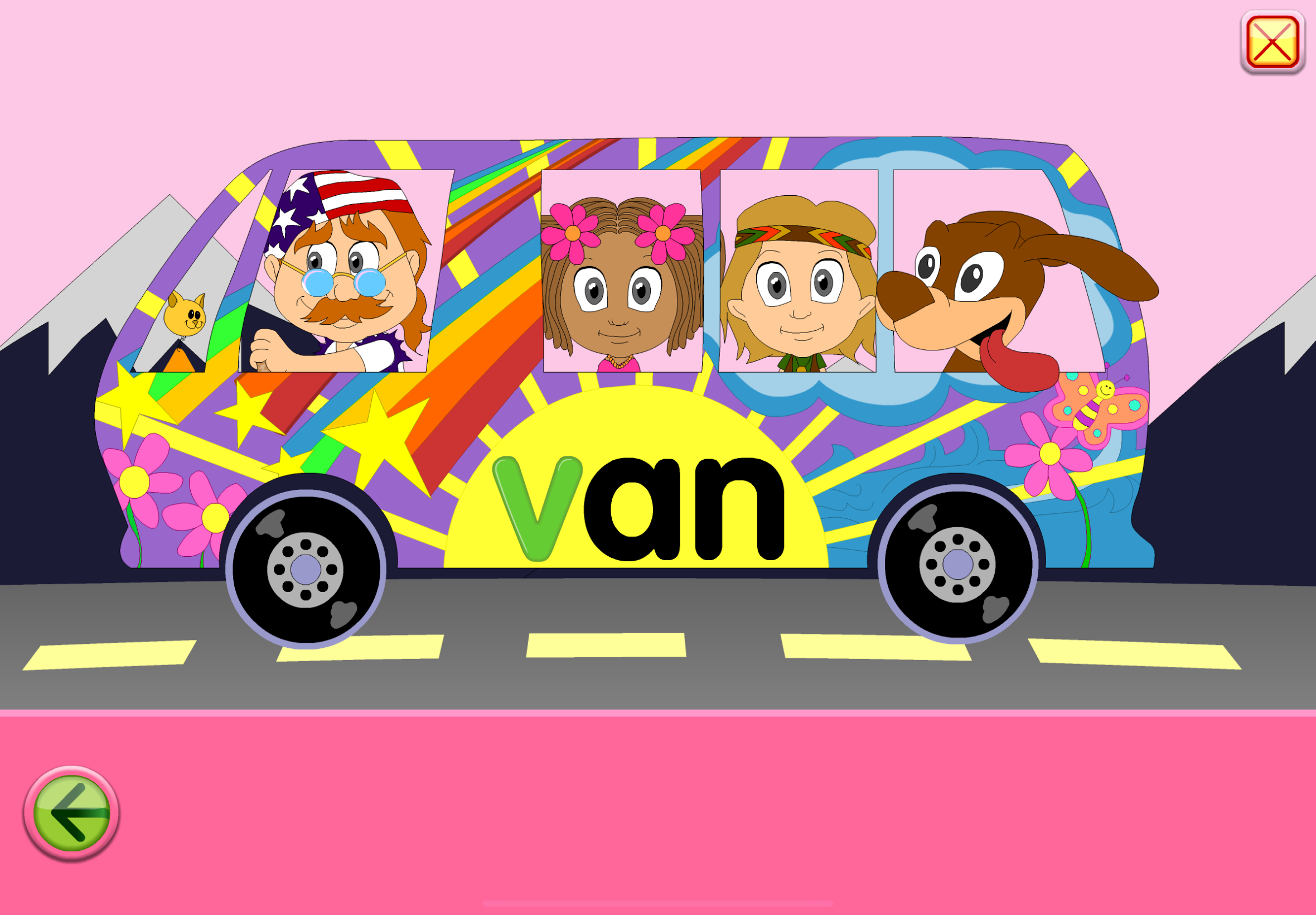
It showed the uppercase and lowercase letters, and then showed pictures with whole words while highlighting the first letter.
(STARFALL PHOTOS: letter Vv with picture of two vacuum cleaners and a groovy coloful van with the word “van” on the side)

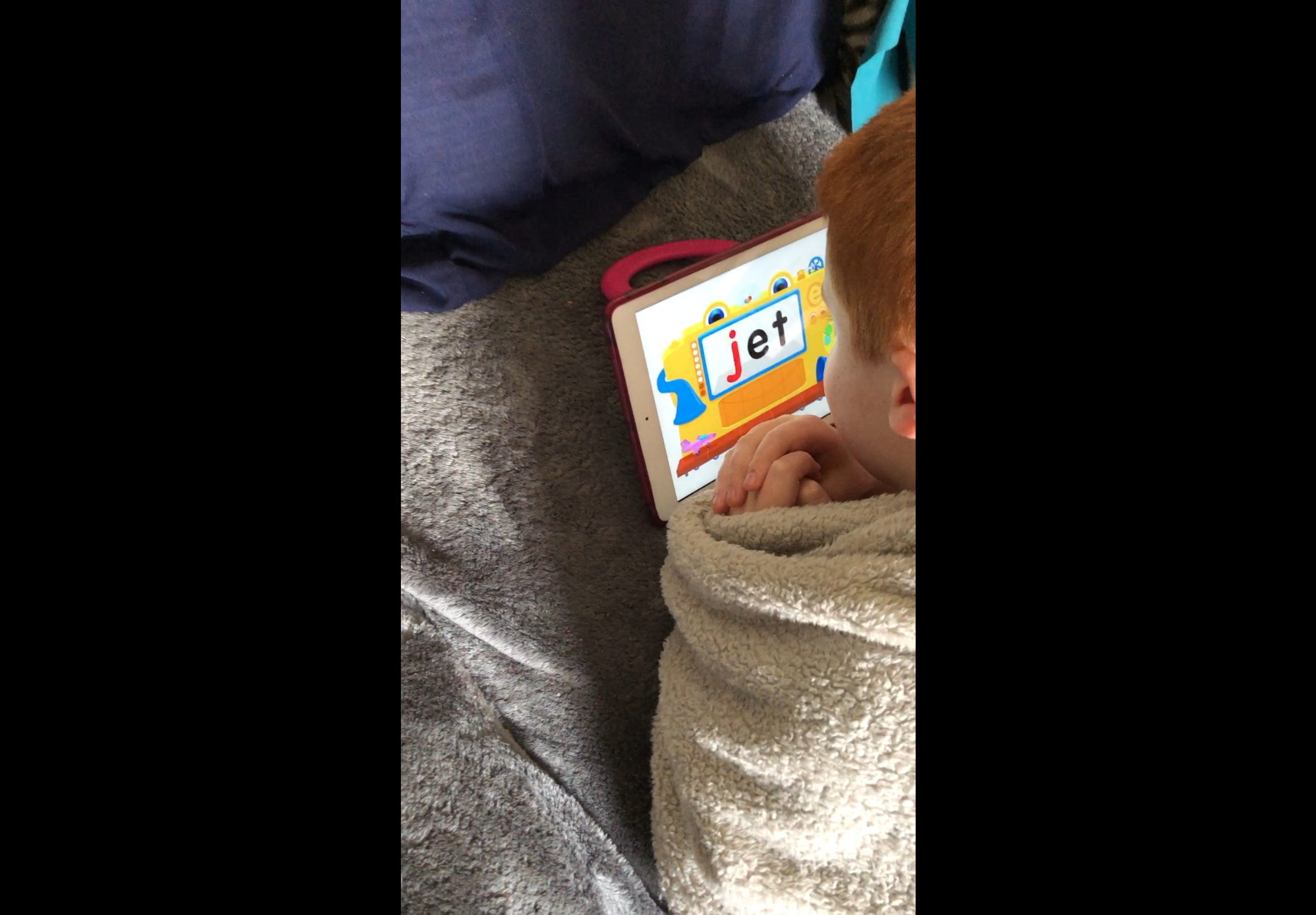
This Starfall app also had a “sound machine” game where you could see words, it highlighted each sound in the words, and with a push of a button or lever it switched out a letter to make a whole new word (jet turned into wet, pet etc.)
(SOUND MACHINE GAME PHOTO: A tween boy is kneeling at a couch watching an ipad with an animation of a yellow sound machine depicting the word jet)
He loved these Starfall app activities so much.
However, there were some phonics media that I offered him and he would literally run out of the room.
One of the literacy media that he could not tolerate was the Youtube phonics songs from the “Rock N Learn” channel.
I thought maybe the music was bothersome, and just shelved it.
When N began to spontaneously segment words off his gestalt phrases (aka delayed echolalia) at close to age 12, I again tried dipping back into offering him adult led synthetic phonics.
He began to be more successful with it.
We did several rounds of learning to segment initial sounds in words with all the letters of the alphabet A-Z. (e.g. words with A-apple, astronaut, alligator etc.)
Then we got to consonant blends, specifically L-blends and R-blends (e.g. BLanket, BLue, GRandma, GRass).
At this point in time, I tried re-offering the “Rock N Learn” song series.
Surprisingly, N loved the songs and watched them happily.
Not only did he love it, he communicated to me that he understood by cleverly pulling up a few home video clips that are embedded in his AAC device.
At the time, I did not fully understand why the change of mind?
Why were the “Rock N Learn” songs so bothersome to him prior to his gestalt language development maturing?
Now that he is almost 15 years old, I have seen even more of his development.
I can see the longer term emerging patterns within his own unique language and literacy development.
When N was primarily in stages 1-2 of gestalt language development, he was not, yet, fully seeing and hearing the individual words in those gestalt phrases.
He was getting the gist of the meaning of some of the gestalt language as a whole and they often made some sense when they unexpectedly and intelligibly ‘popped out’ of his mouth, such as saying “let’s go back to bed” when walking out of a hardware store back to our vehicle in the parking lot.
He knew “let’s go back to bed” meant going back to a place where we started, but was not yet seeing how the word “bed” could be segmented off and the words “the truck” could be ‘slotted in’.
(sidenote: having access to each of his full gestalt phrases programmed on their own single buttons on his AAC app within multiple photographic visual scenes of his personal daily life was the catalyst to him better seeing and hearing those individual words-“let’s go to bed”, “let’s go outside”, “let’s go get a shower” etc.)
At that time, he also saw each letter of the alphabet as its own “whole” picture, a whole symbol, a whole gestalt.
Aa, was a gestalt, Bb was a gestalt, Cc was a gestalt. Each letter stood alone, a complete whole, a totality, in and of itself.
The whole alphabet, ABCDEFGHIJKLMNOPQRSTUVWXYZ, was also a whole gestalt.
I have heard stories of other children who primarily use gestalt language, and are alphabet lovers, becoming dysregulated if a letter was missing from the alphabet.
That was not the case with N, you could hand him just one letter and he was happy as a clam because the single letter was, to him, its own whole gestalt.
In fact, when he was little he would often pick a letter from a letter toy set and carry it around all day like a near and dear friend.
So he did not mind seeing the entire alphabet at once, or letters individually, or seeing whole words starting with those sounds like in the Starfall app, or other ipad apps like Metamorphabet, or the Leapfrog Letter phonics magnet toy.
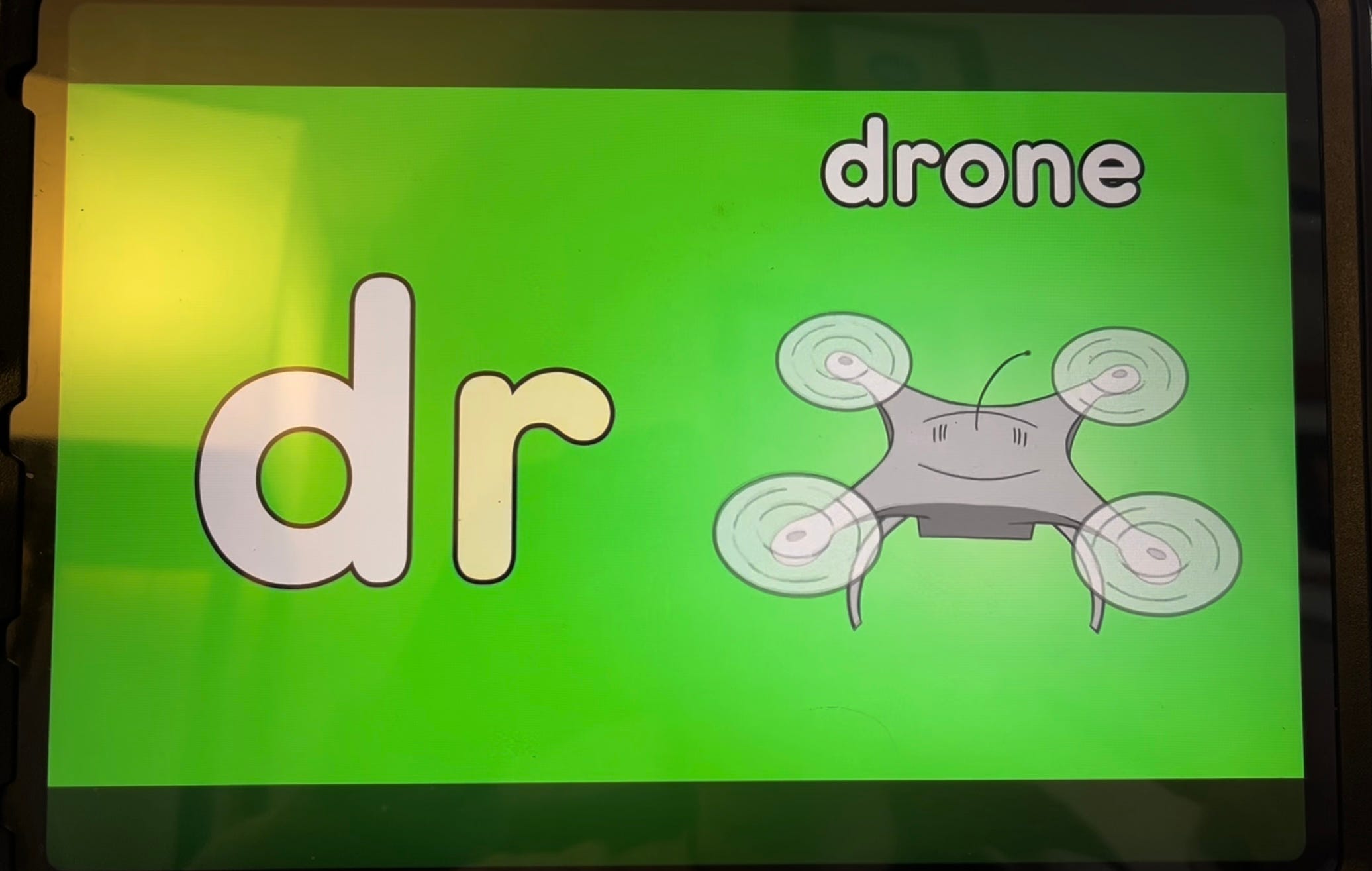
However, in the “Rock N Learn” music videos it flashes a large segmented part of the word, so for the word drone, it flashes and sings the sound “DR-DR-DR” along with the word and picture of a drone.
(Rock N Learn DRONE PHOTO: a screenshot of the Rock N Learn Consonant Blend songs, the letters “dr” are on the left and the word “drone” is on the top right and a picture of a drone is below the word drone)
I speculate, this is just pure hypothesis, that perhaps, initially seeing and hearing these particular videos might have been similar to being presented with a chair with one leg chopped off and the leg set on the floor next to the chair.
Then being asked to participate in sitting in that very chair with that one leg segmented off.
I would certainly decline that opportunity myself, and perhaps I might have run out of the room too.
Once we began supporting N’s gestalt language with the Natural Language Acquisition protocol, his gestalt language development matured, then he began to more clearly see and hear the individual words in his gestalt phrases.
After the emergence of his deepening understanding of the single words within his gestalts, we successfully began our work with adult led intensive synthetic phonics.
From there he began to see, hear, and deepen in understanding that individual words have individual sounds too.
(The whole word CAT has 3 individual sounds within it, C-A-T, in that specific order or sequence, not mashed together like TCA or TAC)
At this conjecture in his gestalt language development when he saw the DR-DR-DR drone song, he did not run out of the room.
He now understood that DR was a partitioned segment from the whole word DRONE.
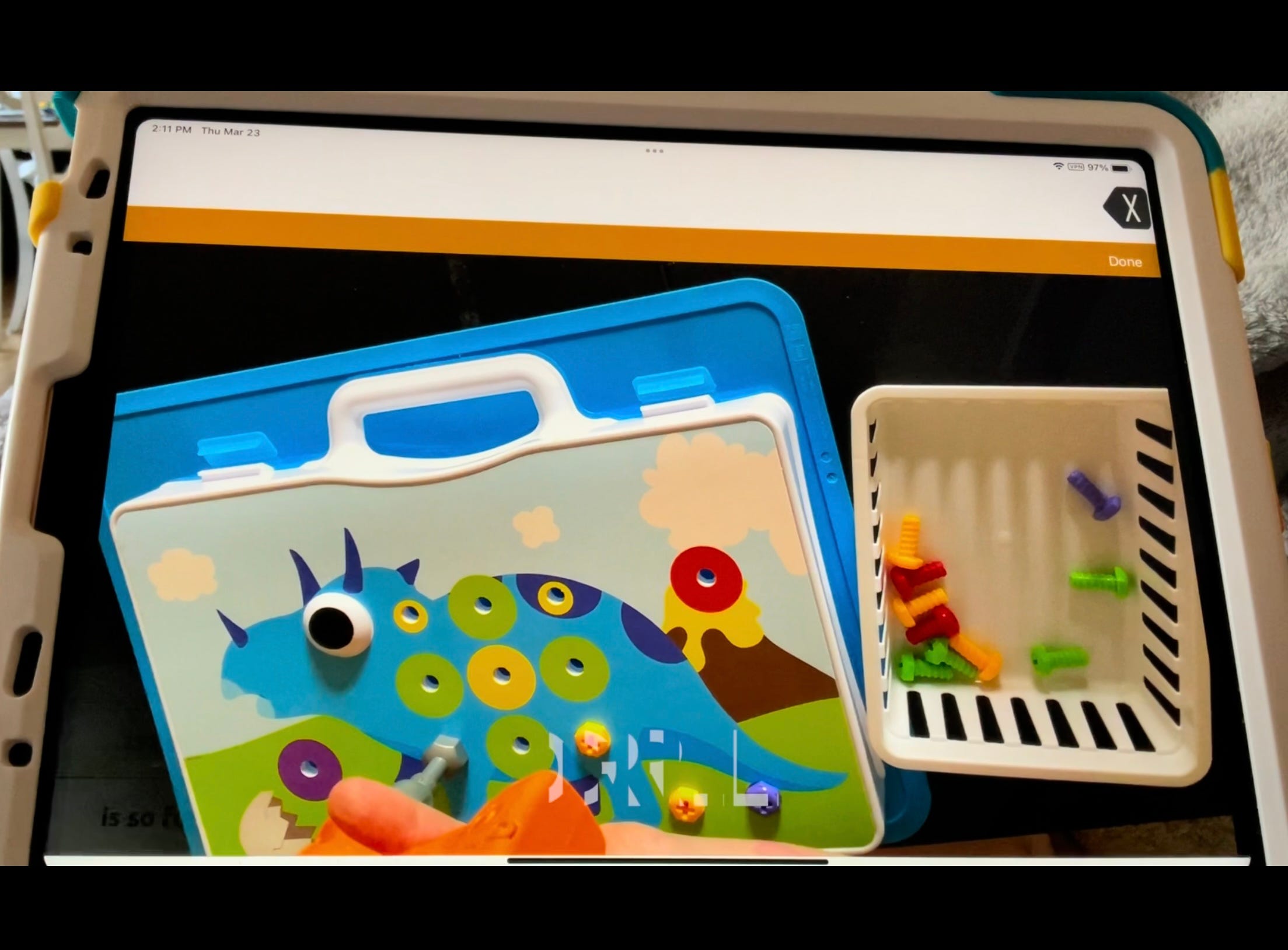
And not only that, he responded by going into his high tech AAC device and pulled up a short home video clip of himself playing with a, DRILL.
There you go, his very own example of segmentation, DR-ill!
(PHOTO: a screen shot of an ipad AAC device depicting a toy drill drilling a bolt into a picture with pre-cut holes )
Now how about that creative communication to knock your socks off?!
Some might think that it was a coincidence, or that he was just “stimming”.
Yet, after the GR-blend song he pulled up another home video clip, this time it was of his GRandfather mowing the GRass.
(PHOTO: a screenshot of an ipad AAC device with a grandfather mowing a grassy lawn and the grandson is walking nearby)
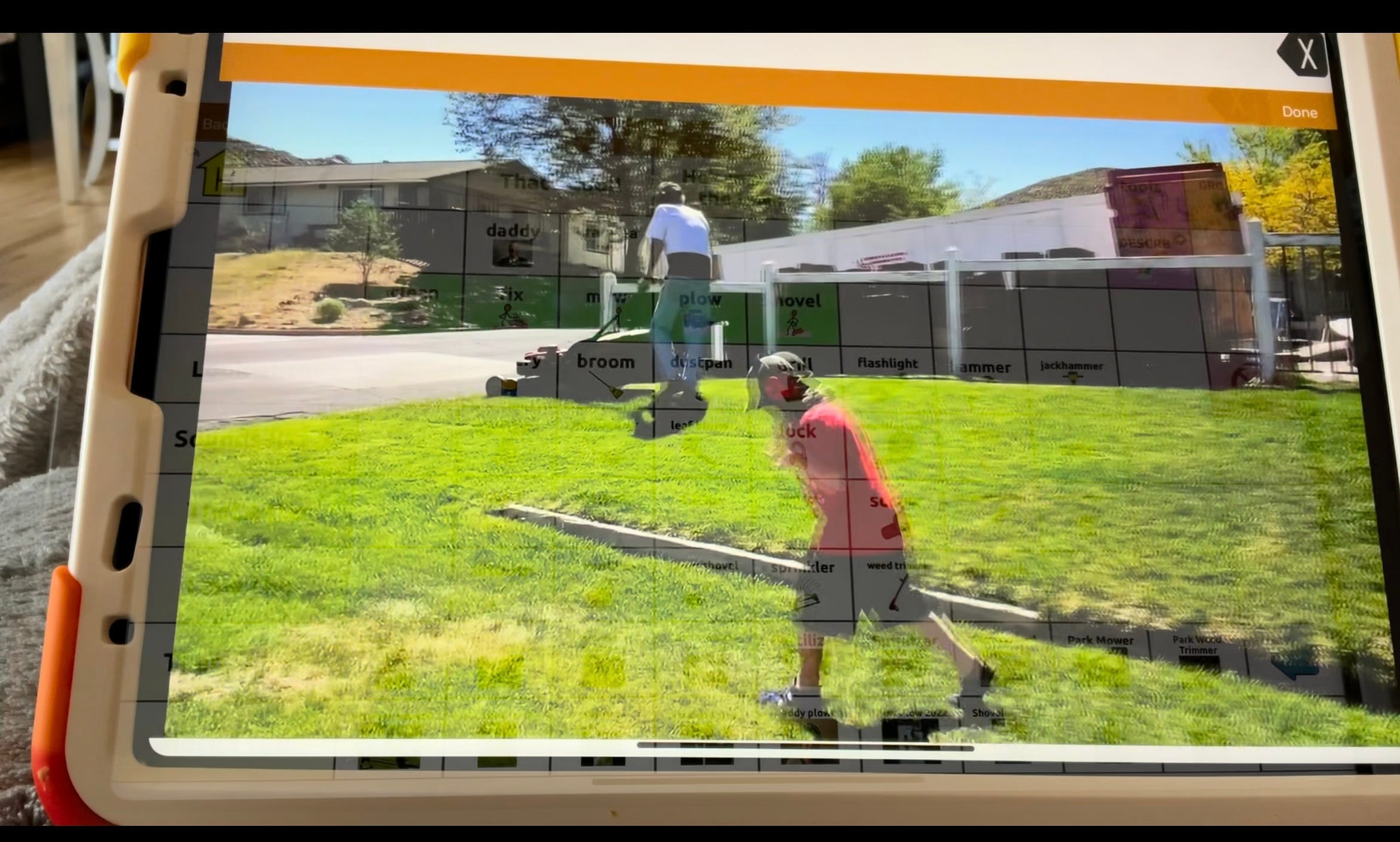
Coincidence? Not so.
Furthermore, after the TR-blend song, he pulled up a home video clip of his GRandpa using a weed TRimmer.
The thing is, he is a gardener at heart and has many home video clips in his AAC device of different people doing yard and gardening work.
These creative communications, using video clips, to share his knowledge were fully intentional and quite revealing of how much he has been taking everything in, even when under a neuronormative lens it often did not look like he was listening at all.
Now to get more serious.
There are conversations going on about whether or not autistic nonspeakers need intensive literacy instruction to include phonics instruction to read and write.
I can’t answer that for other people, but I can answer that for N.
Yes, N can read, but he struggles immensely with spelling and writing.
N’s spelling and writing difficulties are not solely caused by his motor planning disability, dyspraxia.
Dyspraxia is only one part of this multi-layered issue.
There is a family history of both dyspraxia and dyslexia.
He has a very smart close relative that is dyslexic and did not learn to read until age 11, after years of special education support.
Today, this relative is a support to us in supporting N’s literacy journey.
They share with us that reading and writing is still hard and laborious, but today they love devouring 2-inch thick novels.
There is even another compounding layer to N’s obstacles to attaining full literacy, because he also has apraxia of speech.
People with apraxia of speech may also have co-occurring difficulties with reading and writing, especially if the speech disability persists after the age of 5 years old.
There is a current body of research, often termed “science of reading”, in which a statistic is reported that 60-70% of students acquire literacy easily and quickly.
I personally was in this 60-70% of student group. I picked up literacy so lightning fast without intensive instruction around the age of 4 years old.
Reading and writing to me was like breathing, and as a deaf/hard of hearing person it gave me a visual input to language that I needed since I was not allowed to use a signed language.
However, the other part of that statistic is that 30-40% of students do need intensive explicit instruction to acquire full literacy.
Additionally, the educational recommendations for those who struggle with reading or writing, such as those with dyslexia, is none other than explicit intensive literacy instruction.
In spite of being hyperlexic, N completely falls into that 30-40% of individuals who reap tremendous benefit from explicit intensive literacy instruction.
No one should be ashamed of accessing explicit intensive literacy instruction, no matter their disabilities, their age, or in spite of the many strengths or talents that they may have.
One person that I learned that from is an autistic professor at University of Cambridge, UK, Jason Arday, who has shared his own language and literacy development.
Jason Arday did not develop spoken speech until age 9 years old.
After acquiring spoken speech, he still struggled for many years to acquire full literacy.
He tells stories of his teachers who never gave up on him, and worked with him on phonics for years, all the way until he was 18 years old before it finally clicked for him.
And now he is changing the world, as a professor, at a prestigious university.
Intensive explicit literacy instruction can be life changing for the people who need it.
I know it certainly has been life changing for my nonspeaking autistic son.
The work N has done (with calibrated supports) in figuring out how to segment words from gestalt phrases, then to segmenting sounds within those words, is actually boosting his ability to motor plan spelling and writing with alternative pencils such as a keyboard.
He can better see and hear each sound in each word, which is gradually empowering him to begin to reach his hand out to an alternative pencil and select the first sound, then the next, and then the next.
Until maybe someday, like Professor Jason Arday, it will all completely come together for him and he will have yet another modality in his communication toolbox to communicate his knowledge, thoughts, feelings, and ideas.
And if not, that is okay too, because as a multimodal, highly creative communicator he will continue to let himself be known in whatever way works best for him.
(see below for a link to the much shortened video version of this story as well as ‘layman’ references to topics I covered in this blog)
References and Resources:
Video: Youtube link to N of 1 Creative Communication About Phonics Knowledge in 2023
Article: 30-40% of students need intensive explicit literacy instruction
https://www.pbs.org/newshour/education/why-more-u-s-schools-are-embracing-a-new-science-of-reading
Website: Dyslexia Support Recommendations
https://www.mayoclinic.org/diseases-conditions/dyslexia/diagnosis-treatment/drc-20353557
Video: Professor Jason Arday’s language and literacy journey
The Cambridge Professor Who Learned To Read At 18
Article: Apraxia and Reading, Writing Difficulties